> ## Documentation Index
> Fetch the complete documentation index at: https://langchain-5e9cc07a-preview-devupd-1765394015-eccef47.mintlify.site/llms.txt
> Use this file to discover all available pages before exploring further.
# Memory
AI applications need [memory](/oss/javascript/concepts/memory) to share context across multiple interactions. In LangGraph, you can add two types of memory:
* [Add short-term memory](#add-short-term-memory) as a part of your agent's [state](/oss/javascript/langgraph/graph-api#state) to enable multi-turn conversations.
* [Add long-term memory](#add-long-term-memory) to store user-specific or application-level data across sessions.
## Add short-term memory
**Short-term** memory (thread-level [persistence](/oss/javascript/langgraph/persistence)) enables agents to track multi-turn conversations. To add short-term memory:
```typescript theme={null}
import { MemorySaver, StateGraph } from "@langchain/langgraph";
const checkpointer = new MemorySaver();
const builder = new StateGraph(...);
const graph = builder.compile({ checkpointer });
await graph.invoke(
{ messages: [{ role: "user", content: "hi! i am Bob" }] },
{ configurable: { thread_id: "1" } }
);
```
### Use in production
In production, use a checkpointer backed by a database:
```typescript theme={null}
import { PostgresSaver } from "@langchain/langgraph-checkpoint-postgres";
const DB_URI = "postgresql://postgres:postgres@localhost:5442/postgres?sslmode=disable";
const checkpointer = PostgresSaver.fromConnString(DB_URI);
const builder = new StateGraph(...);
const graph = builder.compile({ checkpointer });
```
```
npm install @langchain/langgraph-checkpoint-postgres
```
You need to call `checkpointer.setup()` the first time you're using Postgres checkpointer
```typescript theme={null}
import { ChatAnthropic } from "@langchain/anthropic";
import { StateGraph, MessagesZodMeta, START } from "@langchain/langgraph";
import { BaseMessage } from "@langchain/core/messages";
import { registry } from "@langchain/langgraph/zod";
import * as z from "zod";
import { PostgresSaver } from "@langchain/langgraph-checkpoint-postgres";
const MessagesZodState = z.object({
messages: z
.array(z.custom())
.register(registry, MessagesZodMeta),
});
const model = new ChatAnthropic({ model: "claude-haiku-4-5-20251001" });
const DB_URI = "postgresql://postgres:postgres@localhost:5442/postgres?sslmode=disable";
const checkpointer = PostgresSaver.fromConnString(DB_URI);
// await checkpointer.setup();
const builder = new StateGraph(MessagesZodState)
.addNode("call_model", async (state) => {
const response = await model.invoke(state.messages);
return { messages: [response] };
})
.addEdge(START, "call_model");
const graph = builder.compile({ checkpointer });
const config = {
configurable: {
thread_id: "1"
}
};
for await (const chunk of await graph.stream(
{ messages: [{ role: "user", content: "hi! I'm bob" }] },
{ ...config, streamMode: "values" }
)) {
console.log(chunk.messages.at(-1)?.content);
}
for await (const chunk of await graph.stream(
{ messages: [{ role: "user", content: "what's my name?" }] },
{ ...config, streamMode: "values" }
)) {
console.log(chunk.messages.at(-1)?.content);
}
```
### Use in subgraphs
If your graph contains [subgraphs](/oss/javascript/langgraph/use-subgraphs), you only need to provide the checkpointer when compiling the parent graph. LangGraph will automatically propagate the checkpointer to the child subgraphs.
```typescript theme={null}
import { StateGraph, START, MemorySaver } from "@langchain/langgraph";
import * as z from "zod";
const State = z.object({ foo: z.string() });
const subgraphBuilder = new StateGraph(State)
.addNode("subgraph_node_1", (state) => {
return { foo: state.foo + "bar" };
})
.addEdge(START, "subgraph_node_1");
const subgraph = subgraphBuilder.compile();
const builder = new StateGraph(State)
.addNode("node_1", subgraph)
.addEdge(START, "node_1");
const checkpointer = new MemorySaver();
const graph = builder.compile({ checkpointer });
```
If you want the subgraph to have its own memory, you can compile it with the appropriate checkpointer option. This is useful in [multi-agent](/oss/javascript/langchain/multi-agent) systems, if you want agents to keep track of their internal message histories.
```typescript theme={null}
const subgraphBuilder = new StateGraph(...);
const subgraph = subgraphBuilder.compile({ checkpointer: true }); // [!code highlight]
```
## Add long-term memory
Use long-term memory to store user-specific or application-specific data across conversations.
```typescript theme={null}
import { InMemoryStore, StateGraph } from "@langchain/langgraph";
const store = new InMemoryStore();
const builder = new StateGraph(...);
const graph = builder.compile({ store });
```
### Use in production
In production, use a store backed by a database:
```typescript theme={null}
import { PostgresStore } from "@langchain/langgraph-checkpoint-postgres/store";
const DB_URI = "postgresql://postgres:postgres@localhost:5442/postgres?sslmode=disable";
const store = PostgresStore.fromConnString(DB_URI);
const builder = new StateGraph(...);
const graph = builder.compile({ store });
```
```
npm install @langchain/langgraph-checkpoint-postgres
```
You need to call `store.setup()` the first time you're using Postgres store
```typescript theme={null}
import { ChatAnthropic } from "@langchain/anthropic";
import { StateGraph, MessagesZodMeta, START, LangGraphRunnableConfig } from "@langchain/langgraph";
import { PostgresSaver } from "@langchain/langgraph-checkpoint-postgres";
import { PostgresStore } from "@langchain/langgraph-checkpoint-postgres/store";
import { BaseMessage } from "@langchain/core/messages";
import { registry } from "@langchain/langgraph/zod";
import * as z from "zod";
import { v4 as uuidv4 } from "uuid";
const MessagesZodState = z.object({
messages: z
.array(z.custom())
.register(registry, MessagesZodMeta),
});
const model = new ChatAnthropic({ model: "claude-haiku-4-5-20251001" });
const DB_URI = "postgresql://postgres:postgres@localhost:5442/postgres?sslmode=disable";
const store = PostgresStore.fromConnString(DB_URI);
const checkpointer = PostgresSaver.fromConnString(DB_URI);
// await store.setup();
// await checkpointer.setup();
const callModel = async (
state: z.infer,
config: LangGraphRunnableConfig,
) => {
const userId = config.configurable?.userId;
const namespace = ["memories", userId];
const memories = await config.store?.search(namespace, { query: state.messages.at(-1)?.content });
const info = memories?.map(d => d.value.data).join("\n") || "";
const systemMsg = `You are a helpful assistant talking to the user. User info: ${info}`;
// Store new memories if the user asks the model to remember
const lastMessage = state.messages.at(-1);
if (lastMessage?.content?.toLowerCase().includes("remember")) {
const memory = "User name is Bob";
await config.store?.put(namespace, uuidv4(), { data: memory });
}
const response = await model.invoke([
{ role: "system", content: systemMsg },
...state.messages
]);
return { messages: [response] };
};
const builder = new StateGraph(MessagesZodState)
.addNode("call_model", callModel)
.addEdge(START, "call_model");
const graph = builder.compile({
checkpointer,
store,
});
const config = {
configurable: {
thread_id: "1",
userId: "1",
}
};
for await (const chunk of await graph.stream(
{ messages: [{ role: "user", content: "Hi! Remember: my name is Bob" }] },
{ ...config, streamMode: "values" }
)) {
console.log(chunk.messages.at(-1)?.content);
}
const config2 = {
configurable: {
thread_id: "2",
userId: "1",
}
};
for await (const chunk of await graph.stream(
{ messages: [{ role: "user", content: "what is my name?" }] },
{ ...config2, streamMode: "values" }
)) {
console.log(chunk.messages.at(-1)?.content);
}
```
### Use semantic search
Enable semantic search in your graph's memory store to let graph agents search for items in the store by semantic similarity.
```typescript theme={null}
import { OpenAIEmbeddings } from "@langchain/openai";
import { InMemoryStore } from "@langchain/langgraph";
// Create store with semantic search enabled
const embeddings = new OpenAIEmbeddings({ model: "text-embedding-3-small" });
const store = new InMemoryStore({
index: {
embeddings,
dims: 1536,
},
});
await store.put(["user_123", "memories"], "1", { text: "I love pizza" });
await store.put(["user_123", "memories"], "2", { text: "I am a plumber" });
const items = await store.search(["user_123", "memories"], {
query: "I'm hungry",
limit: 1,
});
```
```typescript theme={null}
import { OpenAIEmbeddings, ChatOpenAI } from "@langchain/openai";
import { StateGraph, START, MessagesZodMeta, InMemoryStore } from "@langchain/langgraph";
import { BaseMessage } from "@langchain/core/messages";
import { registry } from "@langchain/langgraph/zod";
import * as z from "zod";
const MessagesZodState = z.object({
messages: z
.array(z.custom())
.register(registry, MessagesZodMeta),
});
const model = new ChatOpenAI({ model: "gpt-4o-mini" });
// Create store with semantic search enabled
const embeddings = new OpenAIEmbeddings({ model: "text-embedding-3-small" });
const store = new InMemoryStore({
index: {
embeddings,
dims: 1536,
}
});
await store.put(["user_123", "memories"], "1", { text: "I love pizza" });
await store.put(["user_123", "memories"], "2", { text: "I am a plumber" });
const chat = async (state: z.infer, config) => {
// Search based on user's last message
const items = await config.store.search(
["user_123", "memories"],
{ query: state.messages.at(-1)?.content, limit: 2 }
);
const memories = items.map(item => item.value.text).join("\n");
const memoriesText = memories ? `## Memories of user\n${memories}` : "";
const response = await model.invoke([
{ role: "system", content: `You are a helpful assistant.\n${memoriesText}` },
...state.messages,
]);
return { messages: [response] };
};
const builder = new StateGraph(MessagesZodState)
.addNode("chat", chat)
.addEdge(START, "chat");
const graph = builder.compile({ store });
for await (const [message, metadata] of await graph.stream(
{ messages: [{ role: "user", content: "I'm hungry" }] },
{ streamMode: "messages" }
)) {
if (message.content) {
console.log(message.content);
}
}
```
## Manage short-term memory
With [short-term memory](#add-short-term-memory) enabled, long conversations can exceed the LLM's context window. Common solutions are:
* [Trim messages](#trim-messages): Remove first or last N messages (before calling LLM)
* [Delete messages](#delete-messages) from LangGraph state permanently
* [Summarize messages](#summarize-messages): Summarize earlier messages in the history and replace them with a summary
* [Manage checkpoints](#manage-checkpoints) to store and retrieve message history
* Custom strategies (e.g., message filtering, etc.)
This allows the agent to keep track of the conversation without exceeding the LLM's context window.
### Trim messages
Most LLMs have a maximum supported context window (denominated in tokens). One way to decide when to truncate messages is to count the tokens in the message history and truncate whenever it approaches that limit. If you're using LangChain, you can use the trim messages utility and specify the number of tokens to keep from the list, as well as the `strategy` (e.g., keep the last `maxTokens`) to use for handling the boundary.
To trim message history, use the [`trimMessages`](https://js.langchain.com/docs/how_to/trim_messages/) function:
```typescript theme={null}
import { trimMessages } from "@langchain/core/messages";
const callModel = async (state: z.infer) => {
const messages = trimMessages(state.messages, {
strategy: "last",
maxTokens: 128,
startOn: "human",
endOn: ["human", "tool"],
});
const response = await model.invoke(messages);
return { messages: [response] };
};
const builder = new StateGraph(MessagesZodState)
.addNode("call_model", callModel);
// ...
```
```typescript theme={null}
import { trimMessages, BaseMessage } from "@langchain/core/messages";
import { ChatAnthropic } from "@langchain/anthropic";
import { StateGraph, START, MessagesZodMeta, MemorySaver } from "@langchain/langgraph";
import { registry } from "@langchain/langgraph/zod";
import * as z from "zod";
const MessagesZodState = z.object({
messages: z
.array(z.custom())
.register(registry, MessagesZodMeta),
});
const model = new ChatAnthropic({ model: "claude-3-5-sonnet-20241022" });
const callModel = async (state: z.infer) => {
const messages = trimMessages(state.messages, {
strategy: "last",
maxTokens: 128,
startOn: "human",
endOn: ["human", "tool"],
tokenCounter: model,
});
const response = await model.invoke(messages);
return { messages: [response] };
};
const checkpointer = new MemorySaver();
const builder = new StateGraph(MessagesZodState)
.addNode("call_model", callModel)
.addEdge(START, "call_model");
const graph = builder.compile({ checkpointer });
const config = { configurable: { thread_id: "1" } };
await graph.invoke({ messages: [{ role: "user", content: "hi, my name is bob" }] }, config);
await graph.invoke({ messages: [{ role: "user", content: "write a short poem about cats" }] }, config);
await graph.invoke({ messages: [{ role: "user", content: "now do the same but for dogs" }] }, config);
const finalResponse = await graph.invoke({ messages: [{ role: "user", content: "what's my name?" }] }, config);
console.log(finalResponse.messages.at(-1)?.content);
```
```
Your name is Bob, as you mentioned when you first introduced yourself.
```
### Delete messages
You can delete messages from the graph state to manage the message history. This is useful when you want to remove specific messages or clear the entire message history.
To delete messages from the graph state, you can use the `RemoveMessage`. For `RemoveMessage` to work, you need to use a state key with [`messagesStateReducer`](https://reference.langchain.com/javascript/functions/_langchain_langgraph.index.messagesStateReducer.html) [reducer](/oss/javascript/langgraph/graph-api#reducers), like `MessagesZodState`.
To remove specific messages:
```typescript theme={null}
import { RemoveMessage } from "@langchain/core/messages";
const deleteMessages = (state) => {
const messages = state.messages;
if (messages.length > 2) {
// remove the earliest two messages
return {
messages: messages
.slice(0, 2)
.map((m) => new RemoveMessage({ id: m.id })),
};
}
};
```
When deleting messages, **make sure** that the resulting message history is valid. Check the limitations of the LLM provider you're using. For example:
* Some providers expect message history to start with a `user` message
* Most providers require `assistant` messages with tool calls to be followed by corresponding `tool` result messages.
```typescript theme={null}
import { RemoveMessage, BaseMessage } from "@langchain/core/messages";
import { ChatAnthropic } from "@langchain/anthropic";
import { StateGraph, START, MemorySaver, MessagesZodMeta } from "@langchain/langgraph";
import * as z from "zod";
import { registry } from "@langchain/langgraph/zod";
const MessagesZodState = z.object({
messages: z
.array(z.custom())
.register(registry, MessagesZodMeta),
});
const model = new ChatAnthropic({ model: "claude-3-5-sonnet-20241022" });
const deleteMessages = (state: z.infer) => {
const messages = state.messages;
if (messages.length > 2) {
// remove the earliest two messages
return { messages: messages.slice(0, 2).map(m => new RemoveMessage({ id: m.id })) };
}
return {};
};
const callModel = async (state: z.infer) => {
const response = await model.invoke(state.messages);
return { messages: [response] };
};
const builder = new StateGraph(MessagesZodState)
.addNode("call_model", callModel)
.addNode("delete_messages", deleteMessages)
.addEdge(START, "call_model")
.addEdge("call_model", "delete_messages");
const checkpointer = new MemorySaver();
const app = builder.compile({ checkpointer });
const config = { configurable: { thread_id: "1" } };
for await (const event of await app.stream(
{ messages: [{ role: "user", content: "hi! I'm bob" }] },
{ ...config, streamMode: "values" }
)) {
console.log(event.messages.map(message => [message.getType(), message.content]));
}
for await (const event of await app.stream(
{ messages: [{ role: "user", content: "what's my name?" }] },
{ ...config, streamMode: "values" }
)) {
console.log(event.messages.map(message => [message.getType(), message.content]));
}
```
```
[['human', "hi! I'm bob"]]
[['human', "hi! I'm bob"], ['ai', 'Hi Bob! How are you doing today? Is there anything I can help you with?']]
[['human', "hi! I'm bob"], ['ai', 'Hi Bob! How are you doing today? Is there anything I can help you with?'], ['human', "what's my name?"]]
[['human', "hi! I'm bob"], ['ai', 'Hi Bob! How are you doing today? Is there anything I can help you with?'], ['human', "what's my name?"], ['ai', 'Your name is Bob.']]
[['human', "what's my name?"], ['ai', 'Your name is Bob.']]
```
### Summarize messages
The problem with trimming or removing messages, as shown above, is that you may lose information from culling of the message queue. Because of this, some applications benefit from a more sophisticated approach of summarizing the message history using a chat model.
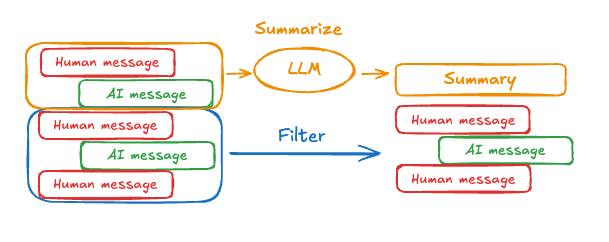 Prompting and orchestration logic can be used to summarize the message history. For example, in LangGraph you can include a `summary` key in the state alongside the `messages` key:
```typescript theme={null}
import { BaseMessage } from "@langchain/core/messages";
import { MessagesZodMeta } from "@langchain/langgraph";
import { registry } from "@langchain/langgraph/zod";
import * as z from "zod";
const State = z.object({
messages: z
.array(z.custom())
.register(registry, MessagesZodMeta),
summary: z.string().optional(),
});
```
Then, you can generate a summary of the chat history, using any existing summary as context for the next summary. This `summarizeConversation` node can be called after some number of messages have accumulated in the `messages` state key.
```typescript theme={null}
import { RemoveMessage, HumanMessage } from "@langchain/core/messages";
const summarizeConversation = async (state: z.infer) => {
// First, we get any existing summary
const summary = state.summary || "";
// Create our summarization prompt
let summaryMessage: string;
if (summary) {
// A summary already exists
summaryMessage =
`This is a summary of the conversation to date: ${summary}\n\n` +
"Extend the summary by taking into account the new messages above:";
} else {
summaryMessage = "Create a summary of the conversation above:";
}
// Add prompt to our history
const messages = [
...state.messages,
new HumanMessage({ content: summaryMessage })
];
const response = await model.invoke(messages);
// Delete all but the 2 most recent messages
const deleteMessages = state.messages
.slice(0, -2)
.map(m => new RemoveMessage({ id: m.id }));
return {
summary: response.content,
messages: deleteMessages
};
};
```
```typescript theme={null}
import { ChatAnthropic } from "@langchain/anthropic";
import {
SystemMessage,
HumanMessage,
RemoveMessage,
type BaseMessage
} from "@langchain/core/messages";
import {
MessagesZodMeta,
StateGraph,
START,
END,
MemorySaver,
} from "@langchain/langgraph";
import { BaseMessage } from "@langchain/core/messages";
import { registry } from "@langchain/langgraph/zod";
import * as z from "zod";
import { v4 as uuidv4 } from "uuid";
const memory = new MemorySaver();
// We will add a `summary` attribute (in addition to `messages` key,
// which MessagesZodState already has)
const GraphState = z.object({
messages: z
.array(z.custom())
.register(registry, MessagesZodMeta),
summary: z.string().default(""),
});
// We will use this model for both the conversation and the summarization
const model = new ChatAnthropic({ model: "claude-haiku-4-5-20251001" });
// Define the logic to call the model
const callModel = async (state: z.infer) => {
// If a summary exists, we add this in as a system message
const { summary } = state;
let { messages } = state;
if (summary) {
const systemMessage = new SystemMessage({
id: uuidv4(),
content: `Summary of conversation earlier: ${summary}`,
});
messages = [systemMessage, ...messages];
}
const response = await model.invoke(messages);
// We return an object, because this will get added to the existing state
return { messages: [response] };
};
// We now define the logic for determining whether to end or summarize the conversation
const shouldContinue = (state: z.infer) => {
const messages = state.messages;
// If there are more than six messages, then we summarize the conversation
if (messages.length > 6) {
return "summarize_conversation";
}
// Otherwise we can just end
return END;
};
const summarizeConversation = async (state: z.infer) => {
// First, we summarize the conversation
const { summary, messages } = state;
let summaryMessage: string;
if (summary) {
// If a summary already exists, we use a different system prompt
// to summarize it than if one didn't
summaryMessage =
`This is summary of the conversation to date: ${summary}\n\n` +
"Extend the summary by taking into account the new messages above:";
} else {
summaryMessage = "Create a summary of the conversation above:";
}
const allMessages = [
...messages,
new HumanMessage({ id: uuidv4(), content: summaryMessage }),
];
const response = await model.invoke(allMessages);
// We now need to delete messages that we no longer want to show up
// I will delete all but the last two messages, but you can change this
const deleteMessages = messages
.slice(0, -2)
.map((m) => new RemoveMessage({ id: m.id! }));
if (typeof response.content !== "string") {
throw new Error("Expected a string response from the model");
}
return { summary: response.content, messages: deleteMessages };
};
// Define a new graph
const workflow = new StateGraph(GraphState)
// Define the conversation node and the summarize node
.addNode("conversation", callModel)
.addNode("summarize_conversation", summarizeConversation)
// Set the entrypoint as conversation
.addEdge(START, "conversation")
// We now add a conditional edge
.addConditionalEdges(
// First, we define the start node. We use `conversation`.
// This means these are the edges taken after the `conversation` node is called.
"conversation",
// Next, we pass in the function that will determine which node is called next.
shouldContinue,
)
// We now add a normal edge from `summarize_conversation` to END.
// This means that after `summarize_conversation` is called, we end.
.addEdge("summarize_conversation", END);
// Finally, we compile it!
const app = workflow.compile({ checkpointer: memory });
```
### Manage checkpoints
You can view and delete the information stored by the checkpointer.
#### View thread state
```typescript theme={null}
const config = {
configurable: {
thread_id: "1",
// optionally provide an ID for a specific checkpoint,
// otherwise the latest checkpoint is shown
// checkpoint_id: "1f029ca3-1f5b-6704-8004-820c16b69a5a"
},
};
await graph.getState(config);
```
```
{
values: { messages: [HumanMessage(...), AIMessage(...), HumanMessage(...), AIMessage(...)] },
next: [],
config: { configurable: { thread_id: '1', checkpoint_ns: '', checkpoint_id: '1f029ca3-1f5b-6704-8004-820c16b69a5a' } },
metadata: {
source: 'loop',
writes: { call_model: { messages: AIMessage(...) } },
step: 4,
parents: {},
thread_id: '1'
},
createdAt: '2025-05-05T16:01:24.680462+00:00',
parentConfig: { configurable: { thread_id: '1', checkpoint_ns: '', checkpoint_id: '1f029ca3-1790-6b0a-8003-baf965b6a38f' } },
tasks: [],
interrupts: []
}
```
#### View the history of the thread
```typescript theme={null}
const config = {
configurable: {
thread_id: "1",
},
};
const history = [];
for await (const state of graph.getStateHistory(config)) {
history.push(state);
}
```
#### Delete all checkpoints for a thread
```typescript theme={null}
const threadId = "1";
await checkpointer.deleteThread(threadId);
```
***
[Edit the source of this page on GitHub.](https://github.com/langchain-ai/docs/edit/main/src/oss/langgraph/add-memory.mdx)
[Connect these docs programmatically](/use-these-docs) to Claude, VSCode, and more via MCP for real-time answers.
Prompting and orchestration logic can be used to summarize the message history. For example, in LangGraph you can include a `summary` key in the state alongside the `messages` key:
```typescript theme={null}
import { BaseMessage } from "@langchain/core/messages";
import { MessagesZodMeta } from "@langchain/langgraph";
import { registry } from "@langchain/langgraph/zod";
import * as z from "zod";
const State = z.object({
messages: z
.array(z.custom())
.register(registry, MessagesZodMeta),
summary: z.string().optional(),
});
```
Then, you can generate a summary of the chat history, using any existing summary as context for the next summary. This `summarizeConversation` node can be called after some number of messages have accumulated in the `messages` state key.
```typescript theme={null}
import { RemoveMessage, HumanMessage } from "@langchain/core/messages";
const summarizeConversation = async (state: z.infer) => {
// First, we get any existing summary
const summary = state.summary || "";
// Create our summarization prompt
let summaryMessage: string;
if (summary) {
// A summary already exists
summaryMessage =
`This is a summary of the conversation to date: ${summary}\n\n` +
"Extend the summary by taking into account the new messages above:";
} else {
summaryMessage = "Create a summary of the conversation above:";
}
// Add prompt to our history
const messages = [
...state.messages,
new HumanMessage({ content: summaryMessage })
];
const response = await model.invoke(messages);
// Delete all but the 2 most recent messages
const deleteMessages = state.messages
.slice(0, -2)
.map(m => new RemoveMessage({ id: m.id }));
return {
summary: response.content,
messages: deleteMessages
};
};
```
```typescript theme={null}
import { ChatAnthropic } from "@langchain/anthropic";
import {
SystemMessage,
HumanMessage,
RemoveMessage,
type BaseMessage
} from "@langchain/core/messages";
import {
MessagesZodMeta,
StateGraph,
START,
END,
MemorySaver,
} from "@langchain/langgraph";
import { BaseMessage } from "@langchain/core/messages";
import { registry } from "@langchain/langgraph/zod";
import * as z from "zod";
import { v4 as uuidv4 } from "uuid";
const memory = new MemorySaver();
// We will add a `summary` attribute (in addition to `messages` key,
// which MessagesZodState already has)
const GraphState = z.object({
messages: z
.array(z.custom())
.register(registry, MessagesZodMeta),
summary: z.string().default(""),
});
// We will use this model for both the conversation and the summarization
const model = new ChatAnthropic({ model: "claude-haiku-4-5-20251001" });
// Define the logic to call the model
const callModel = async (state: z.infer) => {
// If a summary exists, we add this in as a system message
const { summary } = state;
let { messages } = state;
if (summary) {
const systemMessage = new SystemMessage({
id: uuidv4(),
content: `Summary of conversation earlier: ${summary}`,
});
messages = [systemMessage, ...messages];
}
const response = await model.invoke(messages);
// We return an object, because this will get added to the existing state
return { messages: [response] };
};
// We now define the logic for determining whether to end or summarize the conversation
const shouldContinue = (state: z.infer) => {
const messages = state.messages;
// If there are more than six messages, then we summarize the conversation
if (messages.length > 6) {
return "summarize_conversation";
}
// Otherwise we can just end
return END;
};
const summarizeConversation = async (state: z.infer) => {
// First, we summarize the conversation
const { summary, messages } = state;
let summaryMessage: string;
if (summary) {
// If a summary already exists, we use a different system prompt
// to summarize it than if one didn't
summaryMessage =
`This is summary of the conversation to date: ${summary}\n\n` +
"Extend the summary by taking into account the new messages above:";
} else {
summaryMessage = "Create a summary of the conversation above:";
}
const allMessages = [
...messages,
new HumanMessage({ id: uuidv4(), content: summaryMessage }),
];
const response = await model.invoke(allMessages);
// We now need to delete messages that we no longer want to show up
// I will delete all but the last two messages, but you can change this
const deleteMessages = messages
.slice(0, -2)
.map((m) => new RemoveMessage({ id: m.id! }));
if (typeof response.content !== "string") {
throw new Error("Expected a string response from the model");
}
return { summary: response.content, messages: deleteMessages };
};
// Define a new graph
const workflow = new StateGraph(GraphState)
// Define the conversation node and the summarize node
.addNode("conversation", callModel)
.addNode("summarize_conversation", summarizeConversation)
// Set the entrypoint as conversation
.addEdge(START, "conversation")
// We now add a conditional edge
.addConditionalEdges(
// First, we define the start node. We use `conversation`.
// This means these are the edges taken after the `conversation` node is called.
"conversation",
// Next, we pass in the function that will determine which node is called next.
shouldContinue,
)
// We now add a normal edge from `summarize_conversation` to END.
// This means that after `summarize_conversation` is called, we end.
.addEdge("summarize_conversation", END);
// Finally, we compile it!
const app = workflow.compile({ checkpointer: memory });
```
### Manage checkpoints
You can view and delete the information stored by the checkpointer.
#### View thread state
```typescript theme={null}
const config = {
configurable: {
thread_id: "1",
// optionally provide an ID for a specific checkpoint,
// otherwise the latest checkpoint is shown
// checkpoint_id: "1f029ca3-1f5b-6704-8004-820c16b69a5a"
},
};
await graph.getState(config);
```
```
{
values: { messages: [HumanMessage(...), AIMessage(...), HumanMessage(...), AIMessage(...)] },
next: [],
config: { configurable: { thread_id: '1', checkpoint_ns: '', checkpoint_id: '1f029ca3-1f5b-6704-8004-820c16b69a5a' } },
metadata: {
source: 'loop',
writes: { call_model: { messages: AIMessage(...) } },
step: 4,
parents: {},
thread_id: '1'
},
createdAt: '2025-05-05T16:01:24.680462+00:00',
parentConfig: { configurable: { thread_id: '1', checkpoint_ns: '', checkpoint_id: '1f029ca3-1790-6b0a-8003-baf965b6a38f' } },
tasks: [],
interrupts: []
}
```
#### View the history of the thread
```typescript theme={null}
const config = {
configurable: {
thread_id: "1",
},
};
const history = [];
for await (const state of graph.getStateHistory(config)) {
history.push(state);
}
```
#### Delete all checkpoints for a thread
```typescript theme={null}
const threadId = "1";
await checkpointer.deleteThread(threadId);
```
***
[Edit the source of this page on GitHub.](https://github.com/langchain-ai/docs/edit/main/src/oss/langgraph/add-memory.mdx)
[Connect these docs programmatically](/use-these-docs) to Claude, VSCode, and more via MCP for real-time answers.